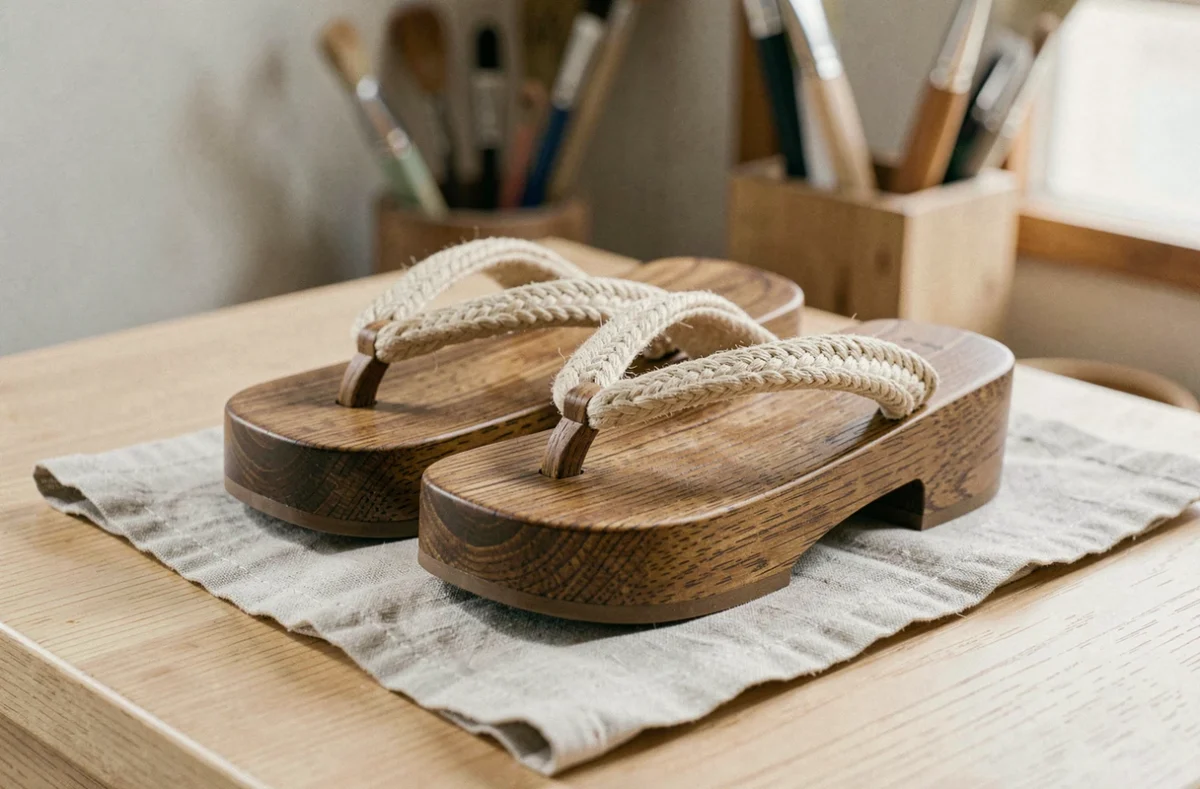
We turn the geta over, run our thumb along the underside, and in a few seconds, we know what we are dealing with. The majority of models sold online as “handcrafted” show visible mechanical assemblies at first inspection. Recognizing high-quality Japanese geta relies on concrete checks of the structure, wood, and strap, not on neat packaging or the label “made in Japan.”
Structural alignment under the sole: the first check to make on a geta
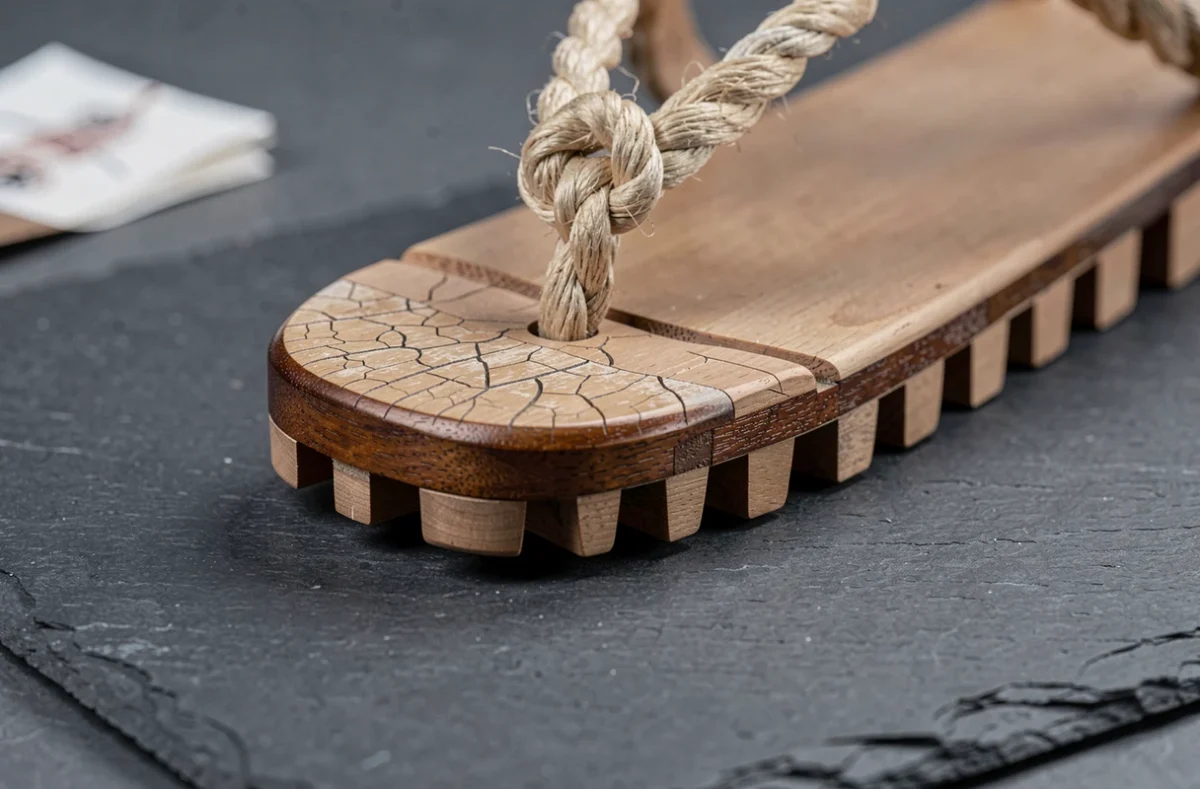
Before looking at decorative finishes, we start with the base. On a handcrafted geta, the teeth are carved from the same block of wood as the platform. This detail is the quickest filter: if the ha (the teeth) are glued, screwed, or fixed with added dowels, we are facing an industrial or semi-industrial product.
The alignment of the teeth under the dai (the platform) is as important as their mode of attachment. Perfectly symmetrical teeth, sanded edges without irregularities, and a regular anchoring of the strap tenon reduce the risks of tipping and splinters. These structural indicators are more reliable than a simple label.
You can also check for the presence of a non-slip layer under the wood. On recent handcrafted models, a thin rubber sole is sometimes added for walking on smooth surfaces. Its absence is not a dealbreaker, but its presence indicates that the artisan has thought about real usage, not just aesthetics. To read the detailed article on Kabanes, these criteria are explored in depth.
Choice of geta wood: paulownia versus dense woods
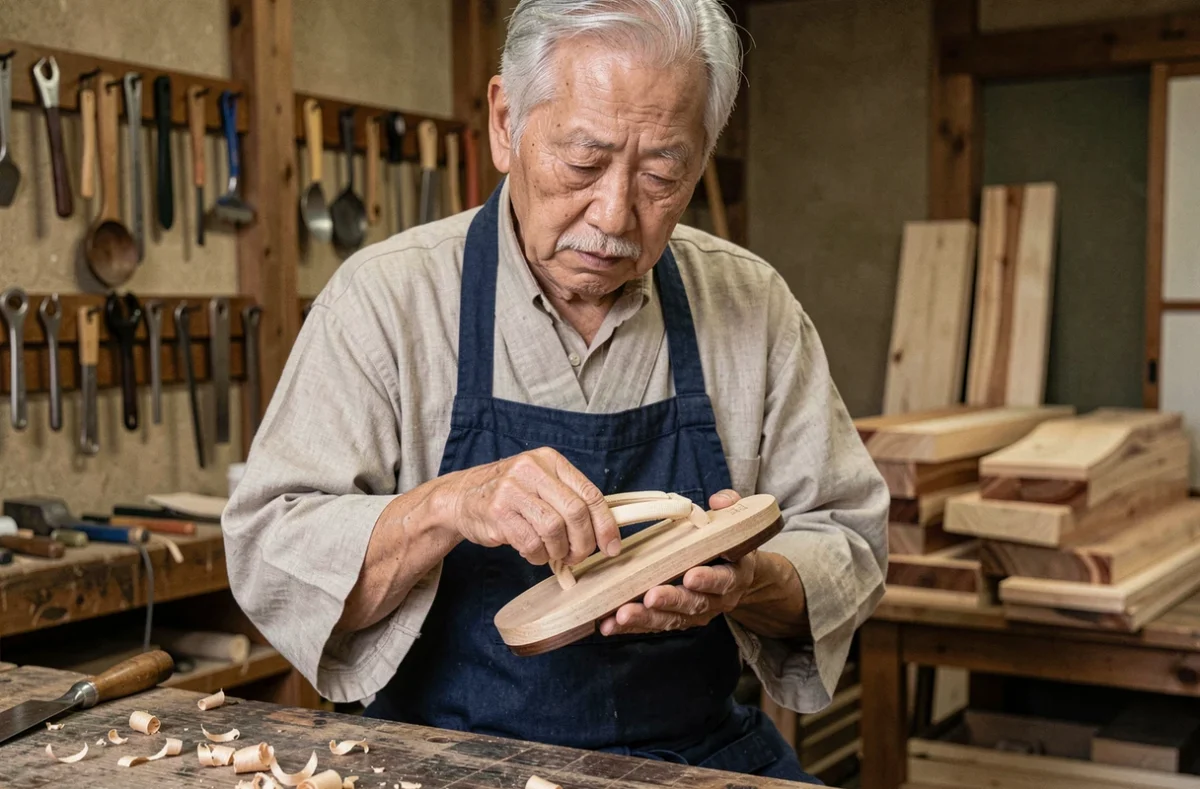
The wood used is not a cosmetic detail. It determines walking comfort, durability, and even the sound produced with each step. Paulownia (kiri) remains the reference wood for Japanese handcrafted geta. It is recognized by its fine grain, cream-white hue, and especially its remarkable lightness.
This wood reduces fatigue during prolonged use and naturally resists moisture. In return, it marks more easily than dense woods. A dai made of paulownia will show visible signs of wear after a few weeks of regular use.
Compromise between weight and durability based on usage
Dense woods (cypress, cedar) absorb shocks better and age without visible marks. The price to pay is a significantly higher weight and a stronger impact with each step, which tires the foot more during long walks.
The type of wood should always be indicated by the seller. Its absence on a product sheet is a warning sign. An artisan working with paulownia will mention it because it is a legitimate selling point. A reseller who remains vague about the type of wood used generally has nothing valuable to declare.
Hand-sewn hanao: recognizing a quality strap on Japanese sandals
The strap (hanao) is the direct contact point with the foot, and this is where the most negative feedback concentrates. On industrial models, the hanao is often made of thin synthetic material, with seams placed on the friction areas between the toes.
On a handcrafted geta, we check three concrete elements:
- The inner padding of the strap, which should be perceptible to the touch. A flat and rigid hanao will cause irritation within the first hour of wear.
- The regularity of the seams, a sign of careful manual assembly. Irregular stitches or threads sticking out betray a sloppy finish.
- The absence of seams directly on sensitive areas (between the big toe and the second toe). This positioning is the primary cause of blisters.
Cotton or synthetic: the fabric of the hanao as an indicator
Cotton is generally softer to the touch and becomes more pliable over time. Synthetic materials can be durable but tend to be more abrasive without proper padding. Feedback varies on this point: some wearers prefer a well-padded synthetic hanao to a poorly assembled cotton one. The quality of the assembly takes precedence over the choice of material.
Traceability of the workshop and product sheet: what distinguishes a handcrafted geta from a copy
The label “made in Japan” is not enough. A product can be assembled in Japan from imported components and mechanical processes. What matters is the traceability of the manufacturing workshop.
A reliable product sheet for handcrafted geta should mention:
- The name or location of the workshop (prefecture, city)
- The type of wood used for the dai
- The material and assembly method of the hanao (hand-sewn or not)
- The carving technique of the ha (monobloc or added)
The absence of this information does not automatically mean that the product is of poor quality, but it prevents any verification. An artisan proud of their work details their method. A seller who relies solely on the aesthetics of the photos often hides manufacturing defects.
Patterns of the hanao and consistency with traditional wear
The patterns of the hanao fabric are not purely decorative in the traditional context. Some patterns are associated with seasons or specific occasions, especially when wearing geta with a yukata in summer or a kimono during formal events. A hanao with patterns inconsistent with the season or outfit is not a technical flaw, but it sometimes reveals a product designed for export without knowledge of the Japanese usage context.
The last reflex to adopt remains the simplest: compare the weight of the pair in hand. An authentic paulownia geta surprises with its lightness. If the sandal weighs as much as a classic city shoe, the wood is probably not what was claimed.