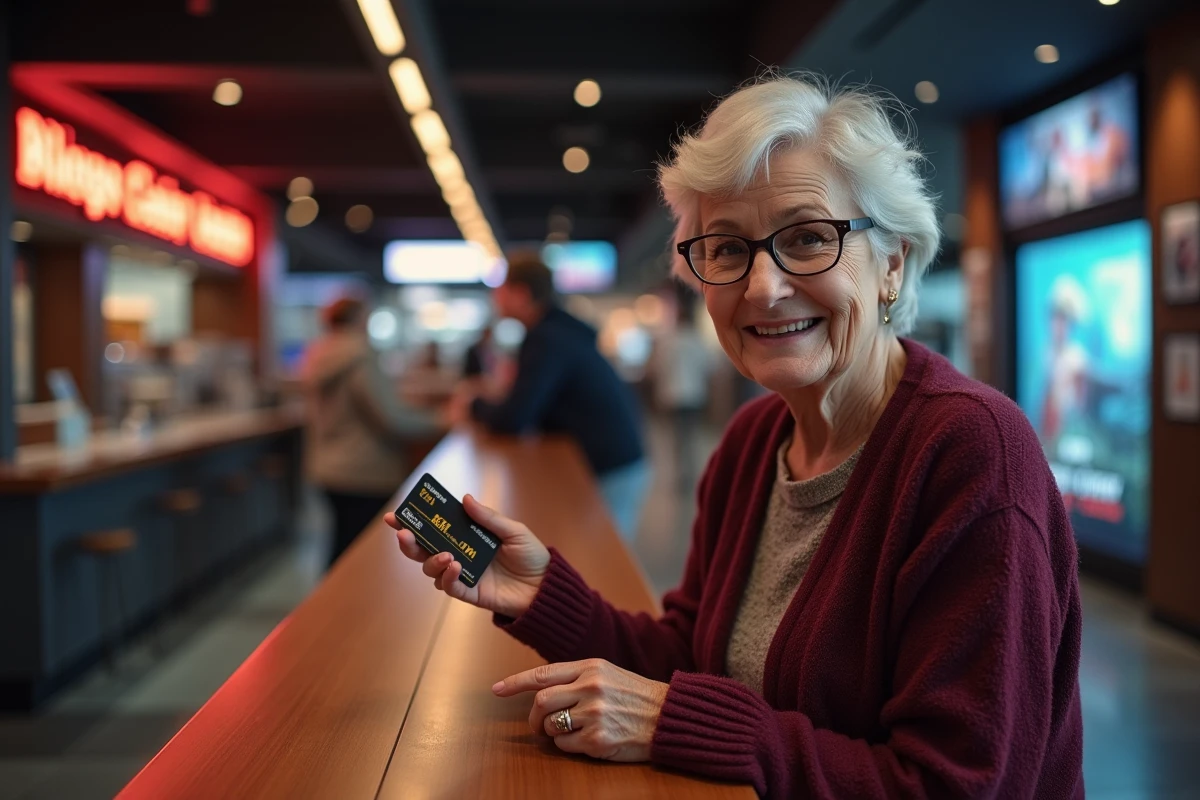
French cinemas have long applied differentiated pricing structures based on the age of the viewer. For those over 60, the senior discount remains the most common lever to pay less for a ticket. Major chains as well as independent cinemas each offer their own formulas, with price differences and conditions that deserve careful examination.
Senior Ticket at the Cinema: What the Individual Discount Really Covers
Even before discussing cards or subscriptions, most cinemas grant a reduced fare to seniors upon simple presentation of an ID. The minimum age varies: 60 years for some operators, 65 years for others. No national regulation imposes a single threshold.
This reduced fare generally represents a few euros less compared to the full price. For a viewer who goes to the cinema once or twice a month, the individual discount is often sufficient. However, beyond three monthly screenings, subscription plans become more advantageous, and this is where specific cards come into play.
Many seniors seeking details about the senior card for the cinema discover that access conditions and prices vary significantly depending on the chain or cinema network.

UGC, Pathé Gaumont, and Independent Cinemas: Comparison of Senior Plans
The two major French networks, UGC and Pathé Gaumont, offer unlimited passes available in a senior version. The principle remains the same as for classic subscriptions (unlimited access to screenings), but at a reduced monthly rate reserved for viewers who have reached the required age.
Unlimited Senior Pass at UGC
The UGC Unlimited Senior card provides access to all screenings within the UGC network without frequency limits. It includes additional benefits such as discounts on 3D glasses and previews. The subscription is billed monthly via automatic payment, with an initial commitment duration specified in the general sales conditions at the time of subscription.
Ciné Pass Pathé Gaumont
Pathé Gaumont offers an equivalent with its Ciné Pass, which operates on a similar model: unlimited screenings, access to premium formats under certain conditions, and a monthly rate adapted for seniors. Both networks regularly adjust their pricing structures, making any price comparison quickly outdated. Checking the current amounts directly on their respective websites remains the most reliable approach.
Independent Cinemas and Art and Essay
The landscape of independent cinemas is evolving. Since 2023, several networks grouped through the French Association of Art and Essay Cinemas (AFCAE) are experimenting with common senior cards across territories (metropolises, departments). These systems allow access to a harmonized preferential rate in several different cinemas, rather than requiring a specific card for each venue.
This territorial mutualization addresses a concrete problem: a viewer who frequents three independent cinemas in their city no longer needs three separate subscriptions. However, feedback from these experiments remains limited, and not all metropolises are covered.
Dedicated Screenings for Seniors: Programming and Accessibility in Theaters
The price reduction is just one aspect of operators’ policies towards the senior audience. Several chains and independent cinemas now schedule specific daytime screenings, often in the early afternoon, with formats that go beyond simple projections.
- Memory and cinema cycles, which pair a film with a thematic discussion, have been developing in art and essay cinemas since 2023
- Health cine-debates, organized in partnership with local organizations, target a retired audience available during the week
- Physical and sensory accessibility is becoming a criterion integrated into senior offers: hearing loops, audio description, wheelchair-accessible seating
These initiatives are documented in reports from the National Federation of French Cinemas (FNCF) and the Observatory of Cinema Attendance. They reflect a strategy of retaining senior audiences that goes beyond preferential pricing, aiming to create a regular meeting point around cinema.

Access Conditions and Pitfalls to Check Before Subscribing
Not all senior cards and subscriptions operate in the same way. Several points deserve systematic verification before any subscription.
- The minimum age required varies by brand: 60 years for some operators, 62 or 65 years for others. No industry standard harmonizes this threshold
- The commitment duration differs: some passes require a commitment of several months, while others operate without commitment after an initial period
- Premium format surcharges (IMAX, Dolby Cinema, 4DX) are not always included in the senior fare, even with an unlimited pass
- The combination with other discounts (holiday vouchers, former employer’s works councils, municipal schemes) depends on each operator
Cities like Lyon and Marseille have implemented municipal schemes that complement the commercial offers of cinemas. These local aids, documented in the 2023-2024 municipal council deliberations, can take the form of cultural vouchers or negotiated rates with local cinemas.
Actual Profitability of a Senior Subscription
An unlimited subscription only becomes profitable after a certain number of screenings per month. For a viewer who goes to the cinema less than twice a month, the individual senior discount often remains more economical than a permanent monthly deduction. The calculation depends on the price of the reduced ticket in the usual cinema compared to the monthly cost of the subscription.
The question of profitability arises differently for viewers who take advantage of daytime screenings during the week, a period when cinemas are less crowded and where some operators apply even lower rates, sometimes close to the cost of the subscription divided by a single screening.
The market for senior cards at the cinema remains fragmented between large national networks, territorial initiatives, and municipal policies. No unique system covers the entire French territory, which forces each viewer to compare the available offers in their living area. The experiments with pooled cards led by the AFCAE could, in the long term, simplify this landscape, but their deployment remains gradual.