
The salary of SNCF executives comes back into public debate with every salary negotiation and every social movement. The gap between the remuneration of a member of the executive committee and that of a TER controller, exposed to assaults at the station, fuels a controversy that goes beyond the simple question of amounts.
Performance objectives of SNCF executives and on-the-ground reality
The variable remuneration of SNCF executives is indexed to performance indicators: punctuality, financial results, customer satisfaction. On paper, this mechanism aligns the interests of management with those of users.
The problem arises when looking at the daily experiences of the agents. Controllers in Occitanie and Paca exercised their right of withdrawal after repeated assaults, notably in Cannes, Toulon, and Port-la-Nouvelle. These incidents have permanently disrupted TER traffic. The teams describe a “knot in the stomach” before each shift.
You can consult Rachel Picard’s salary on Autour 2 Moi to gauge the orders of magnitude that separate the remuneration of a member of the executive committee from that of a station agent. The gap fosters lasting resentment among railway workers, especially since the performance criteria used for the variable part do not take into account the insecurity faced by frontline staff.
No variable remuneration indicator measures the risk of assault on agents. The objectives focus on macro results (revenue, punctuality rate), not on the actual working conditions of teams in contact with the public.
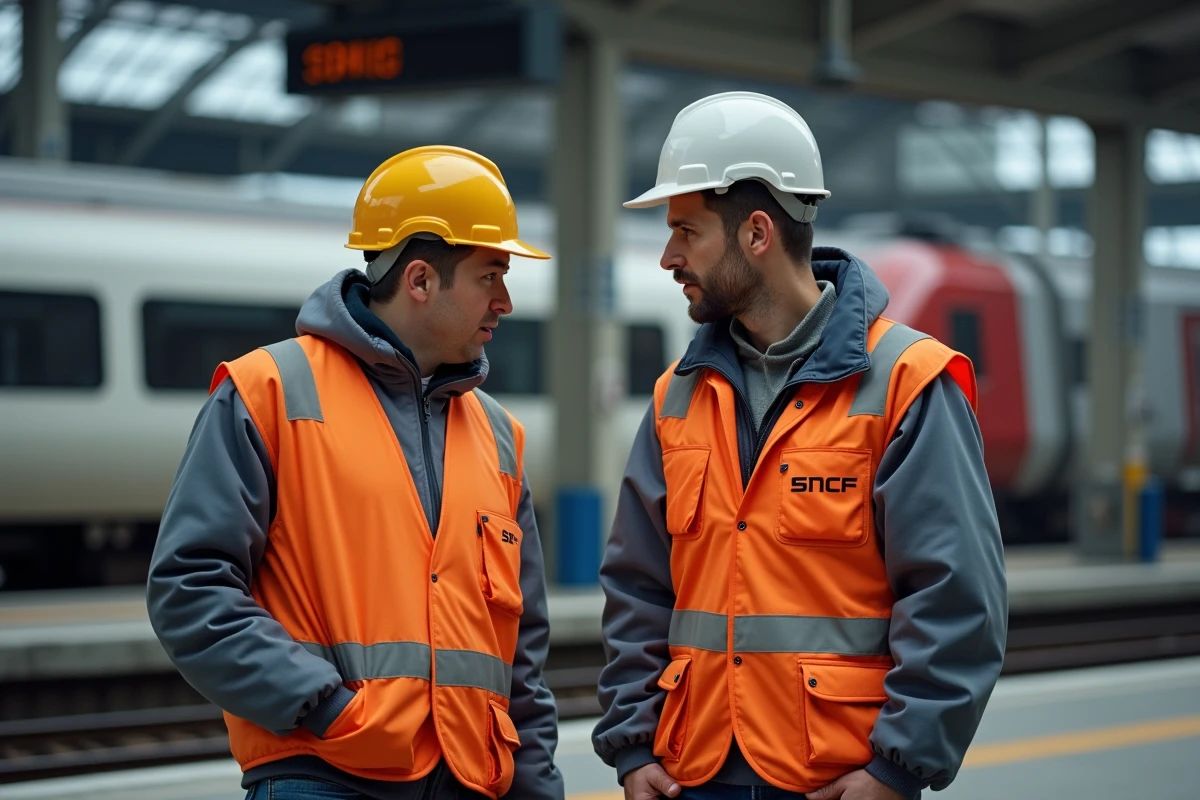
SNCF executives’ salaries in the face of railway workers’ salary increases
At the end of 2024, the annual negotiations resulted in a revaluation consisting of a general increase of 0.5% and individual increases related to seniority averaging around 1.7%, totaling 2.2%. The CEO of SNCF emphasized that this figure exceeds inflation.
Unions contest this reasoning. Their argument: the company generates significant profits, and the salary progression of agents remains out of sync with that of executives. We are talking about remuneration in the hundreds of thousands of euros for members of the executive committee, while a station agent or a controller earns a salary close to the national average.
What the unions are bringing to the table
- The group’s profits, which former CEO Jean-Pierre Farandou himself invoked to justify funding social measures for the end-of-career situations of railway workers
- The gradual elimination of ticket counters in regions, denounced by CGT-Cheminots as an “organized desertification” of public services in Grand Est, Creuse, or Puy-de-Dôme
- The intensification of local mobilizations in 2026, with recurring strikes in Grenoble and Puy-de-Dôme against job cuts
Railway workers are not only contesting the pay gap, they criticize the redistribution model for financing executive bonuses while reducing the number of staff in contact with the public.
Understaffing and SNCF ticket counter closures: the true engine of anger
The salary controversy is not only about amounts. It crystallizes a broader discomfort related to chronic understaffing in certain regions. When a ticket counter closes, it is the remaining agents who absorb the workload, the complaints, and sometimes the aggression from users.
The CGT mobilizations of 2025 and 2026 specifically target this link: staffing levels are reduced to improve the financial ratios on which part of the variable remuneration of executives is based. This creates a vicious cycle perceived as unfair by the agents.
When financial performance is built on the backs of public service
Job cuts improve the productivity indicators used to calculate management bonuses. Feedback on this point varies by region, but the pattern is recurring: fewer agents, more tensions, and executives whose variable pay increases.
This mechanism explains why debates about the salary of the CEO or members of the executive committee go far beyond the question of the gross amount. It touches on the very conception of public rail service and the distribution of the value created by the company.
SNCF executives’ remuneration and public enterprises: a special status
SNCF remains a public company, partly funded by taxes and regional subsidies. This status changes the nature of the debate compared to a publicly traded private company.
When the CEO of a CAC 40 group receives a high salary, shareholders vote in a general assembly. At SNCF, the “shareholders” are taxpayers and users. They have no vote, but they directly suffer the consequences of budgetary arbitrations: canceled trains, closed ticket counters, extended wait times.
The taxpayer indirectly finances the variable remuneration of executives without having a comparable control mechanism to that of private shareholders. It is this asymmetry that makes the controversy so persistent in France.
The European context adds a layer of complexity. The opening to competition (Trenitalia, other operators) pushes SNCF to align its remuneration practices with the private sector to attract management profiles. Unions see this as a drift: we are privatizing top-level remuneration while maintaining the constraints of public service at the base.
The controversy over SNCF executives’ salaries will not be resolved by a simple cap. As long as performance criteria ignore the working conditions of agents and understaffing fuels both accounting profits and service deterioration, this issue will continue to shape social negotiations within the company.